Why bring this to the arcade version?
The PlayStation port of Marvel vs. Capcom lets the active fighter cancel one Super into another. The arcade game does not offer that same flow. Direct Hyper Cancel began by bringing it to the CPS-2 version, then added qualified Special-to-Super routes and a set of visual changes. In the game's own terminology, these Supers are Hyper Combos.
v8 takes the next step: a partner handoff through the incoming fighter's native team Super, alongside the existing same-fighter routes. REMIX and ARCADE live in one installer, with REMIX selected by default. v8 is out as of 2026-09-11 — the installer is above, and the release receipt states which checks ran on this exact build and at what tier. The v7 files remain in the archive, and their parity/roster edition names continue to mean what they meant when they shipped.
What changed between testing and release
Two fixes landed on the r4 candidate, both in mvc.10, fifty bytes together.
The handoff post has the
mechanism for each.
The partner's Hyper draws its background. The cross route hands the incoming
fighter a Hyper without initialising its animation state. A Hyper's script waits
at its second step for an event the animation driver writes into $003C(a6)
once a frame timer expires; that timer was never armed, so the event never came,
the script never advanced, and the background graphics load at $0983F4 was
never reached. Six bytes inside the v8 author's own post-commit hook — three of
its reserved nops, where a6 is already the incoming fighter and the REMIX
gate has passed — write the event the animation would have written. Confirmed
in play on 2026-09-10 after four withdrawn attempts; 1,501 log lines with zero
differences against the base on a 125-second ordinary-play scenario.
Level 4 fills yellow. The game tells the meter's fill colour apart by tile,
not by palette: $7020 is drawn with pen 8 (yellow), $7030 with pen 9 (red).
The REMIX HUD routine puts the bar tile in d4 and the level in d5 before
jumping to the base draw; the two jumps now go through a stub that swaps d4 to
$7020 when d5 is 4. Forty-four bytes, no palette row written, levels 1, 2, 3
and 5 byte-for-byte stock. Forty frames of continuous Supers with both meters
cycling all five levels, diffed whole-frame against stock: every differing pixel
is inside the meter strip.
What the receipt does not say is that the full pinned lane table ran on this build. It ran on the r4 candidate underneath; the two fixes were verified on a headless fixture and by hand. The Windows installer was rebuilt byte-identically on two machines and driven through twelve hostile-archive cases with the Python patcher; the PowerShell path on this exact file is still to run. Each line carries its own status.
What makes a handoff valid?
A button press is only the beginning. The source move must be eligible, its contact must belong to the right fighter and move, and the incoming fighter must be available. Meter, posture and native Duo state are checked before the handoff can commit. Repeated handoffs need a fresh legal request from the currently owned move; an old projectile must not authorize an unrelated action.
That is also why the tests include rejected inputs. A successful handoff and a properly refused one are both necessary to understand the mechanic. Starting a Super later, after the original move has ended, does not prove a cancel.
What MVC2 taught the handoff
I brought the original MVC2 measurement rig back into MAME and replayed its controller inputs. That let me observe when the incoming fighter appears, when the native team Super commits, when meter is spent, and when the partner actually becomes point. Those are separate events, even when the screen makes the handoff look instantaneous.
That ordering informs the MVC1 implementation: a request is followed by a native commitment and an actual change of point fighter. The MVC1 tests measure those events in its own engine, including a second handoff and an outgoing projectile that remains active. This does not claim frame-for-frame MVC2 timing.
Three handoffs, side by side
The word covers three different mechanics across this family of games, and the difference is the design problem. Two things decide it: who acts next, and who chooses what they do.
The arcade original does none of the three, which is where the project started.
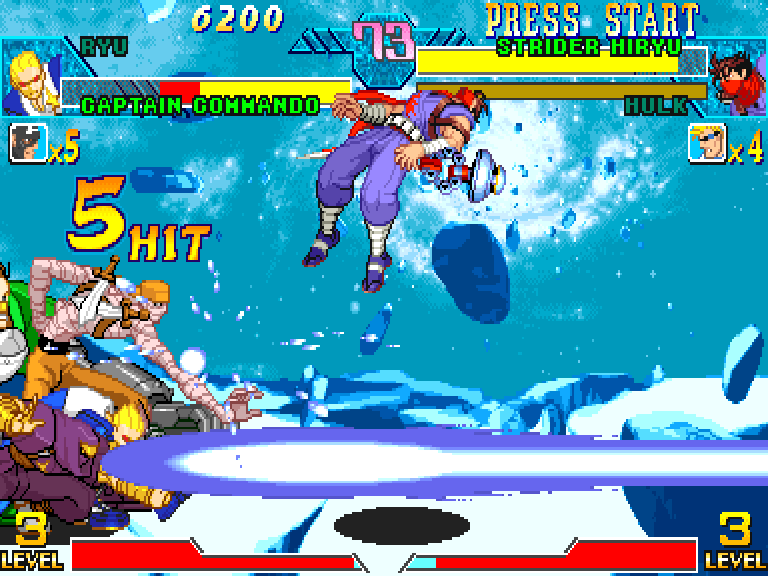
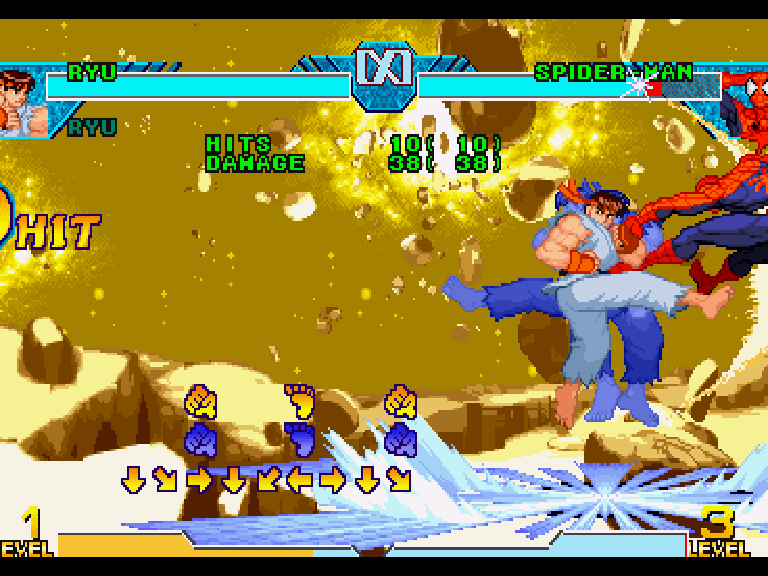
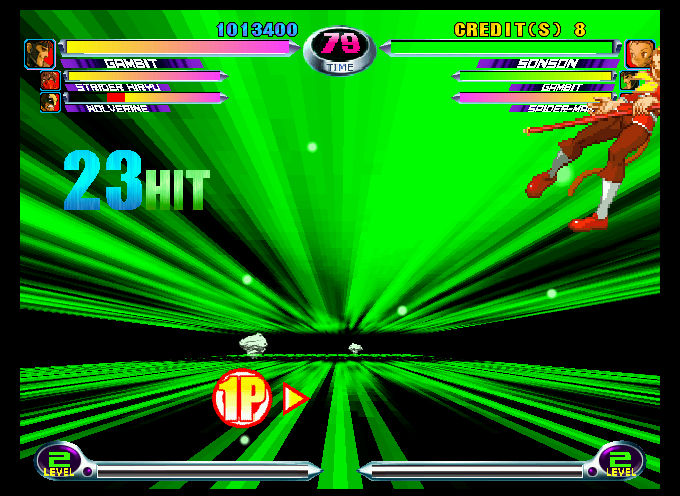
That last property is the one v8 does not have. Its handoff destination comes from the incoming fighter's own data, not from what was typed. Closing that gap is a located change rather than a new system — the route already resolves the partner, already checks contact and generation, and already writes the request the engine consumes. It does not read the requested destination the input path has already stored for it.
That work is deliberately not in this release.
In the testing builds a partner handoff drew no background: the outgoing fighter's cleared and nothing replaced it. The first diagnosis blamed per-side presentation ownership and produced four patches that forced a teardown or re-armed the presentation by hand; every one of them was withdrawn. The actual cause was upstream of all that. The incoming fighter's Hyper script was stalled at its second step waiting for an animation event that the cross route had never set up, so the background was never even requested. Supplying that event — six bytes, no stub — is what shipped. See the handoff post.
MvC2 teams are three fighters, so a chain can run three legs. MvC teams are two. A two-fighter team contains one handoff and no routing change alters that. What is reachable here is MvC2's choice, not MvC2's chain.
The routes players asked for
Captain Storm into Captain Sword, Shield Slash into Final Justice, and Captain Corridor into Sword are explicit regression cases. Each is attempted with ordinary commands on both sides, through the original move's contact and into the next Super. The Hulk grab report also gets a clean-control comparison, including the captive's release and recovery after the cancel.
In those player reports, “arcade” refers to the CPS-2 version of the game. In v8's selector, ARCADE means the original mechanics; the added cancels and partner handoffs belong to REMIX. That distinction matters when trying a reported route.
Why effects need an owner and a lifetime
A cancelled move can leave a beam or helper on screen. Deleting every object with the same appearance is too broad: a new move may already have reused that object slot, and another projectile may be supposed to continue.
The v8 cleanup work checks the exact owner, source action and allocation generation before following the native free path. The object pools are observed through allocation and release, including reused slots. Ryu's projectile continuing through a handoff is useful evidence of legitimate overlap; it should not disappear simply because the active fighter changed.
What the release evidence must show
The combined candidate must pass repeated regressions on both sides, with controller inputs, actual native move entry, contact and meter changes retained in the raw trace. Palette checks follow all four team positions through the relevant presentation states. STYLE checks include a second player joining, rounds, rematches and a new selection.
Counter boundary tests are labeled as such. A controlled display-shadow seed followed by a real hit can test 99, 100 or 999 and the held digits; it is not a naturally played 999-hit combo. Release footage must preserve that distinction.
Player reports about Magnetic Shockwave, Mega Man/Roll and Gold War Machine are part of this work. A reproduced problem, a verified correction and an unresolved report are recorded separately. Static build checks and selected successful clips do not establish that every requested fix is finished.
The result is a stock-size, patch-only release. The installer verifies the
clean parent, creates a separate output and rejects wrong revisions, duplicate
or missing members, modified inputs and existing output paths — twelve of those
cases are exercised in the receipt. The installer, the receipt and the trailer
footage refer to the same candidate, 63cfd090….
The earlier releases
v7 expanded the special-source table and added a destination posture gate. Its two editions expose different route policies: parity follows the selected PlayStation cancel rules; roster retains the documented extensions. v6 added the earlier cancelled-Super cleanup to the combined feature set. Their original files, checksums, change logs and v6 reel are in the release archive above.
Further reading: six color choices, the expanded hit display, and five Hyper levels. The archived article and receipts preserve the previous engineering record; they do not certify v8.
Work note
I designed the changes and acceptance scope, reverse-engineered the native command and object systems, and confirmed the partner-background fix by hand before it shipped. AI agents assisted with disassembly, implementation, harness work, release checks and the trailer. Diagnostics remain diagnostics: the release receipt names each check's tier, and the lanes that have not run on this build are listed as not run rather than passed.
This is an unaffiliated fan modification. Marvel vs. Capcom and its characters belong to their respective owners. The download contains patch data; you supply your own lawful game dump.