Updated Oct 8, 2026 · clean parent: Japan 990512, NO CD.
ROM-free, member-checked community preview. Fresh V4.3 checks cover 420 report-renderer cases, 140 lifecycle checks, the recorded Two-Player and six-owner Party sessions, CPU continuation and badge/capacity/savestate behavior. The full V4.2 gameplay evidence remains inherited under its original identities. Physical controllers, native Windows/macOS frontend play and real online sessions remain unverified. Local CPU assistance does not detect network disconnects.
The inherited V4.2 receipt separates raw-tag and CPU tests, explicit DHC manifests, stock accounting, report rendering, savestate continuation and reproduced bug controls. The named DHC matrices are not every possible source/destination pairing. Where reached, a neutral-state probe checks recovery; early refused routes exit before that probe. The DHC sweeps do not press movement inputs.
Separate bug recipes require later movement or a playable next fight. Report rendering and human/CPU continuation have their own checks. Every result is bound to its actual game and core; native Windows/macOS, physical controllers and real online play remain unverified.
Historical V4/V4.1 receipts remain available under their original version paths. They are not relabelled as new V4.2 test runs. The V4.3 receipt separately binds the current report renderer, both winner sides, original owner controls, save/restore and capacity checks. Inherited gameplay tests retain their V4.2 build identity.
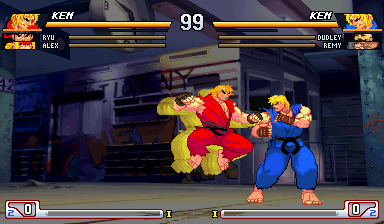
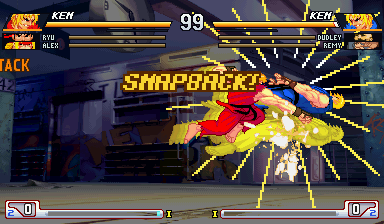
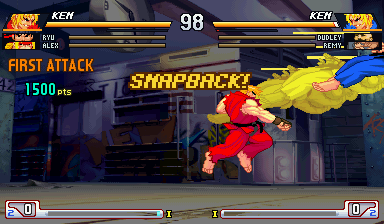
Matched recipes, explicit baseline labels and a focused visual cue connect each video to its outcome. These are our presentation choices, informed by visual-anchor tutorial research; they are not proof of fighting-game learning gains.
The cards above start with the public review: the reproduced problem, our independent repair and a matched before/after capture. Each comparison names its original build. The project owner’s requests for a held match review and CPU roles appear separately. Five fresh V4.3 feature clips show the current game; remaining historical footage keeps its recorded labels.
What Justin Wong Mode means
Justin Wong Mode is a fan nickname, not a commissioned or approved mode. It describes configurable teams: one to five fighters per side, six fighters maximum in total. V4.2 lets a human choose both team sizes against the CPU and gives Party explicit human/CPU roles. The name does not imply that Justin requested, tested or endorsed these changes.
Use the download and setup guide above. Two-Player Tag gives each human a whole roster; its game stays named sfiii3nr1.zip. Party Edition gives each human their own fighter, with optional dedicated CPU teammates; it uses sf3tag.zip and the matching SF3 TAG RetroArch core. Keep each ZIP zipped.
Both editions are built from your own clean Japan 990512 NO-CD sfiii3nr1.zip. Downloads contain patches and tools, not a game ROM. Build from the clean parent rather than an older modified output. Follow Fightcade setup or RetroArch Party setup for your chosen edition.
Public observations and reproduced repairs
Justin Wong’s 7 October 2026 review reacts to GuileWinQuote’s analysis of original Third Strike. It is not an identified TAG playtest. Original analysis and Justin’s reaction retain their individual speaker, date and timestamp in the cards.
The Temporal Thunder/Aegis report concerns a reflected projectile hitting its caster, then resuming an invalid animation command. The narrow repair lets the native hits finish, the projectile disappear and control return. V4.1 introduced the repair; V4.2 retains it.
The Remy neutral-throw/Aegis freeze occurs when Aegis interrupts Remy before his kick completes the throw. The stranded victim can remain trapped through time-over. The repair releases that orphaned victim through the normal reaction path. Remy still takes the Aegis hit; ordinary throws retain their damage.
Ken’s neutral throw finishing Makoto could strand the KO sequence. The reproduced cleanup defect is guarded, and the controls require a later playable fight alongside ordinary nonlethal and reserve-KO behavior. Justin’s 18:03 review segment led to that investigation.
Justin’s Genei Jin discussion led us to test active installs through forced tags. We found a TAG-specific V4.1 visual defect: Yun could return with powered attacks but without the green afterimage cue. V4.2 restores that cue without restarting the timer or spending another stock. This was our follow-up finding, not a defect Justin directly reported. The review’s later infinite discussion concerns Second Impact.
These are focused repairs for reproduced failures. They do not remove every legacy unblockable, option select or balance concern. The wider public-feedback queue remains distinct from the features requested for this project.
Project-owner requests: the restored V4.3 breakdown
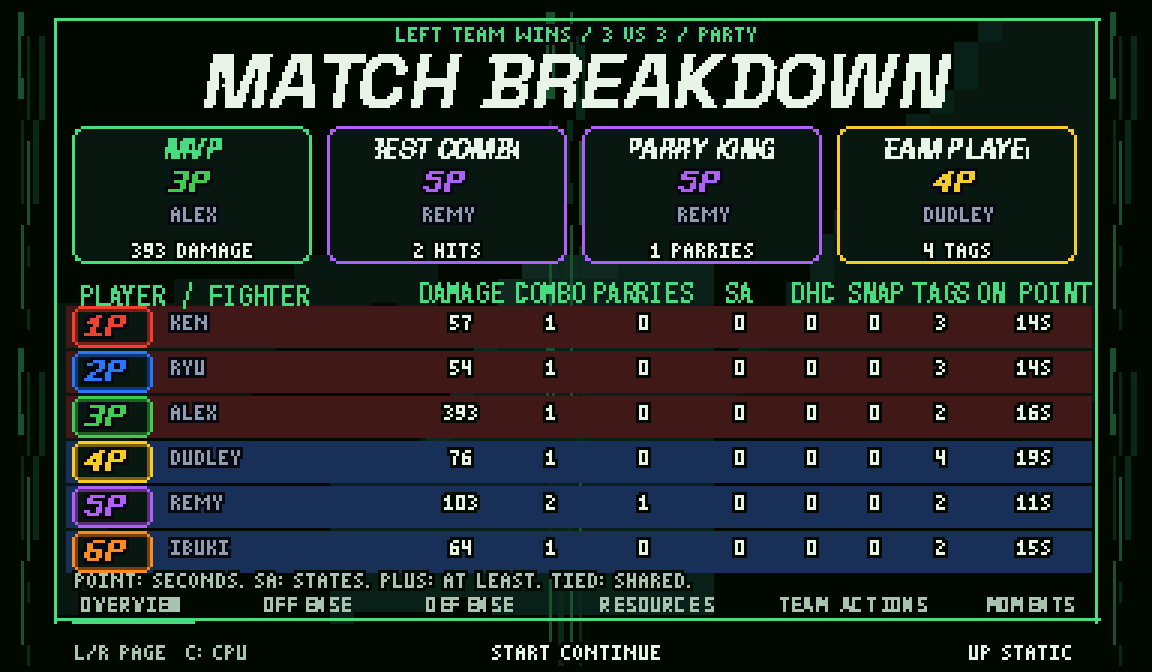
V4.3 restores the earlier colorful title, four award cards, large controller badges and team rows. Its eight-column overview returns, enriched with six pages and 24 recorded counter cards. The winner is announced before this native overlay. The game then holds six destinations—Overview, Offense, Defense, Resources, Team Actions and Match Moments—until a deliberate continuation. Left/right changes page; up selects static or fading page changes. All original human owners release Start, one makes a fresh Start press, then everyone releases Start again.
The report displays observed events and per-fighter data. Human/CPU segments keep input authority identifiable. Point ticks include native freezes. The overview follows the old rounded tick/60 seconds display; other pages show raw ticks. Neither is exact wall-clock time. The recent-event ring is bounded. Unsupported throw-tech, punish and parry-subtype classifications are not inferred, and the report does not synthesize skill grades.
One human can choose both sizes and rosters from 15 legal CPU formats. Party’s MP/MK controls add/remove dedicated CPU slots on the chosen side. A fresh Start + LK explicitly recovers undecided or unready owners; inactivity alone does not fill roles or approve votes.
During a fight, a fresh Start + LK + MK requests CPU assistance or reclaims the original owner’s fighter at a safe actor/bench boundary. Dedicated CPU slots and assisted human fighters remain distinct. This local authority policy does not repair a lost network peer.
The retained V4 tag and meter design
Immediate handoff → protected entry kick → vulnerable landing pose → control. The outgoing fighter becomes visual-only immediately, poses and retreats while the partner enters. That visual cannot attack, be targeted or earn Personal Action bonuses.
On normal landing, the incoming fighter loses protection and poses for 40 action ticks. Hitstop and superfreeze pause the timer. During the pose you cannot attack, block, parry, move, jump or tag. A hit, throw or KO interrupts the pose permanently. These rules apply to voluntary raw tags; DHC, snapback and KO replacement keep their own policies.
When starting stocks are enabled, a fresh reserve’s first DHC now spends exactly one of its own stocks. Eligible routes retain character-specific gauge dimensions and projectile, install, throw and hold restrictions. A request waits up to 90 frames and ends when the outgoing Super Art ends.
The compact power meters use a cyan-to-blue fill distinct from the gold life bars, with stock dots centered beneath the Super Art label. Native capacities, stock costs and install countdowns remain intact. Time-over compares actual remaining health as a share of each team’s starting health; recoverable red life does not count, and equal shares reach Third Strike’s original judges.
What the preview evidence covers
Current receipts bind named gameplay, report, CPU-role, accounting and save/restore checks to their actual game/core identities. The explicit DHC outcome matrices are not every possible source/destination pairing. Neutral-state probes run where the route reaches that stage; early refused requests exit before it. The DHC sweeps do not press movement inputs. Separate bug recipes require later movement or a playable next fight.
Historical V4/V4.1/V4.2 gameplay evidence keeps its original identity. V4.3 reruns focused report, ownership, capacity and save/restore checks; inherited gameplay coverage is identified separately. Physical controllers and real online sessions remain pending, as does native Windows/macOS acceptance. The Linux emulator evidence does not establish those results.
For a report, include V4.3, the edition, operating system, emulator/core, controller ports and exact error or gameplay sequence. For installation failures, include the source set and installer output; for DHC, include both characters, Arts and stocks.
SF3 TAG is an unofficial, fan-made mod. It is not affiliated with, sponsored by or endorsed by Capcom or Justin Wong. Neither commissioned or approved these changes.