Shuma-Gorath was the test I could not pass by making one character look right. Dark Sakura had shown that MvC1 could be forced to accept a native fighter id; Shuma had to prove the method could carry a second character's real MSHvSF logic into a game that never shipped him.
The first diagnosis sent the work in the wrong direction. His sprite region measured 7.95 bits per byte, which looked like an unknown compression format and put 30–50 hours of codec archaeology on the plan. The sprites were never compressed. The analysis tool had applied CPS-2 opcode decryption to plaintext data. Read through the correct view, the same region measured 4.43, and all 11,587 tiles came through the existing pipeline.
That correction changed the decision: relocate his real code block, re-enter it through narrow trampolines, and accept no milestone until it survived live play. I directed that program and decided which fixes entered the build chain. Claude Code agents served as investigators, harness operators, and adversarial checkers; the emulator captures and regression gates, not their reports, are the proof.
Goal: Put Shuma-Gorath -- a character Capcom never shipped in Marvel vs Capcom 1 -- into the game as a native fighter: his own MSHvSF code and animations running inside MvC1, not a sprite swap over someone else's moveset.
Constraints: No source, encrypted program code, a secret character-id ($30) that falls off the end of every per-character table, and a custom 64MB graphics core that has to hold his tiles without breaking any stock character.
Approach: Relocate an entire block of his real MSHvSF logic into unencrypted arena space and re-enter it through trampolines; extract his tiles with the same pipeline built for Dark Sakura; then fix, one live-gated increment at a time, every crash the past-end table reads cause.
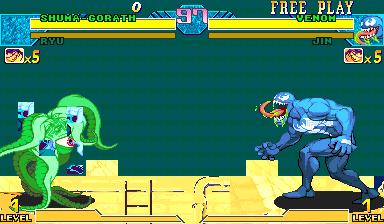
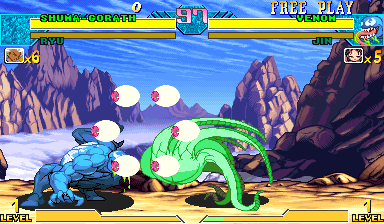
Result: He commits from the select screen with no cheat code, loads, and traverses relocated animation data under his native id. His name reads SHUMA-GORATH. A historical live build of Mystic Stare spawned six eyeballs in a hexagonal ring, but the current destination has not passed complete contact, damage, stun, teardown and reaction parity. The port is an integration build, not a finished fighter.
Proof: A live 23-second gameplay capture (below), a separate six-dimension adversarial pass on the names, and a fresh re-derivation and screenshot gate for every byte of the eyeball build. Claude Code agents performed those checks under refutation prompts; they are verification tools here, not the source of truth. The method, including its confident failures, is documented in the methodology post.
Artifacts: The companion Dark Sakura native port (the recipe he generalized) and the deployed ROM lineage.
August 8 Character Lab: source truth and the destination gap
The revamped harness now pins Shuma's source and destination ROM identities and expands his work into 36 required lanes. Only 1/36 is closed, and it is the documented waiver for a non-applicable persistent flight mode. Prior match traces, the six-eye visual and stock-roster survival remain observations until their named behavior gates carry every required artifact.
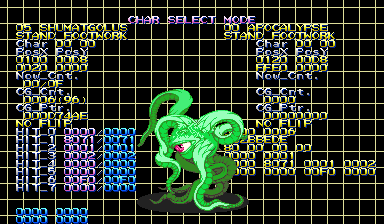
The source HIT and CATCH rooms now provide reproducible animation and paired throw/victim indexes.
The destination does not yet provide the symmetric view: MvC's CATCH editor cycles through its 22
stock rows without a native $30 entry, while the current combined native build's automated HIT
scan returns to boot/title and fails its positive control. That is a harness finding and an engine
integration defect—not permission to substitute a stock row.
This audit also retracts every older damage conclusion derived from fighter object +$7C. That
field is not health; the live health field is +$270. Devitalization and both supers may finish an
animation while remaining indistinguishable from heavy kick in the broad suite, so none is accepted
until command, unique parent state, source animation, active boxes, +$270 damage, stun, cancels,
victim reaction, recovery and audio all agree.
Why This One
I started with Marvel Super Heroes a long time ago, when I was a child. And I saw this weird, weird creature — green, sometimes purple, with six or seven arms. I was like, what is that thing? Then I noticed I liked it. Playing with it was funny. It was flexible. I thought: this is awesome.
Then I moved past those games, and the green creature wasn't there anymore. Marvel vs. Capcom came out without him. Nobody really plays with this thing. Nobody really likes it. So I thought — let me go try to bring that thing back.
That meant going into the code, finding the green creature inside Marvel Super Heroes vs. Street Fighter, looking at what was similar between the two games, and importing him piece by piece.
The eyeballs were the hard part. I couldn't find anything in Marvel vs. Capcom to borrow from, because nothing in that game does what his Mystic Stare does — nobody had six projectiles coming out at once, spinning in a circle. It wasn't there. It was a new thing, so I had to build it and work harder for it.
I wanted to give up on that too. It was taking so much time and eating so many credits, and I'm the only one doing this. People told me to give up. Who cares about this game? Who wants to play it? Why are you putting your time into that? There's so much out there to do — AI is opening up all these avenues, and here you are wasting your life on an old game.
I kept going.
The Blocker That Wasn't
Dark Sakura proved the native recipe: import a character from Marvel Super Heroes vs Street Fighter into MvC1 by running her own relocated code, not by force-fitting her onto a stock fighter. Shuma-Gorath ($30) was the test of whether it generalized -- and he arrived with a scary flag: sprite data that measured 7.95 bits/byte of entropy, the signature of a compression codec CPS-2 doesn't have.
The "compression" was our own tool's garbage: an analysis dump had run CPS-2 opcode decryption over plaintext data in the same address range. Read through the correct data view, his animation tree is an ordinary table (entropy 4.43), his 11,587 tiles walk out with the exact pipeline built for Dark Sakura, and his idle stance -- authentic green body, palette solved -- rendered on the first try. The full telling, with the entropy chart, is in the Dark Sakura native port; the war-story version, with the machinery that caught it, is in the methodology post.
Relocating the Whole Block
Where Dark Sakura's port leans on shared engine paths, Shuma's relocates an entire block of his real MSHvSF code. The block $0301DE..$032A3E is copied verbatim into unencrypted arena space at $3FA060 and re-entered through trampolines, so his logic runs as his own code rather than being fitted onto anyone else's spine. The instructions his relocation displaces are replayed cleanly on the way in. The block is 10,336 bytes — $032A3E minus
$0301DE — and it does not move to a convenient hole; it moves to the only
space on the bus that is not encrypted at all:
- 1stock program$000000–$0301DE · 192.5 KBOpcode fetches here are decrypted by the CPS-2 hardware.
- 2his MSHvSF code block$0301DE–$032A3E · 10.1 KB10,336 bytes, copied verbatim. This is the source, not the destination.
- 3stock program$032A3E–$23C000 · 2.04 MB
- 4thunks and helpers$23C000–$23D600 · 5.5 KBEverything I wrote to get in and out: $23C018, the voice helper $23C222 and its table $23C852, the type-$78 trampoline $23CF70, the win-crash clamp $23D4C8.
- 5stock program$23D600–$3F0000 · 1.70 MB
- 6unencrypted arena$3F0000–$400000 · 64 KBThe relocated copy lands at $3FA060 and runs as his own code. The 2-byte spike fix sits at $3FB75A; the eyeball handler at $3FC8C0.
- Athe block lands here$3FA060 · marker
- Beyeball handler$3FC8C0 · marker
flowchart LR
    A["stock dispatch<br/>for char-id $30"] --> B["trampoline<br/>into arena"]
    B --> C["relocated block $3FA060<br/>(was $0301DE..$032A3E)"]
    C --> D["his own logic runs"]
    D --> E["return trampoline<br/>back to engine spine"]
    F["displaced originals<br/>replayed verbatim"] -.->|clean re-entry| B
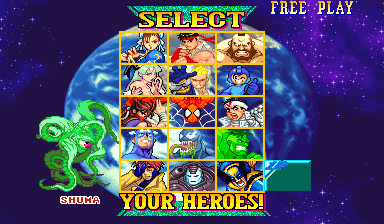
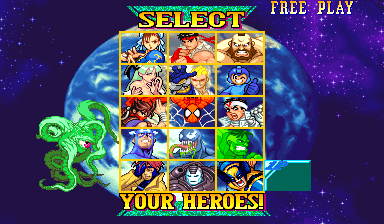
He commits from the character select with no cheat code -- one cell to the right of Wolverine. His name reads SHUMA on the select grid and SHUMA-GORATH on the lifebar, and the old Iron Spider branding is gone from both screens, verified by an independent six-dimension adversarial pass that included a GFX poison test.
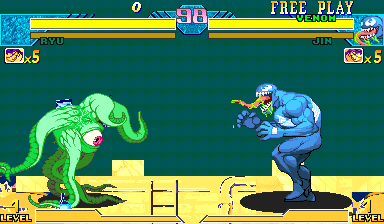
The Defect Behind His Crashes
Shuma kept tripping crashes that felt unrelated -- a knockdown crash, ×5.94 damage, corrupted stun, a pinned camera, garbage sounds -- and they share one root cause: every per-character table in the engine has exactly 23 entries (ids $00..$2C), and $30 reads past the end of all of them. Capcom left no half-wired 24th row to finish -- $30 was never provisioned at all, and its sibling $2E only resolves because it borrows Spider-Man's $0E entry. A 203-site census of the past-end reads exists, and because the tables are packed with zero slack (id $30 physically aliases the next table's first rows), every fix has to be a reader-side clamp or redirect, never a table rewrite -- the knockdown crash, for instance, fell to one byte (0x3D359, d1 -> d0), and the ×5.94 damage clamped back to ×1.0. The master defect gets its full treatment -- diagram, fingerprint-by-fingerprint breakdown, and the census -- in the Dark Sakura native port.
Mystic Stare: An Eyeball That Actually Flies
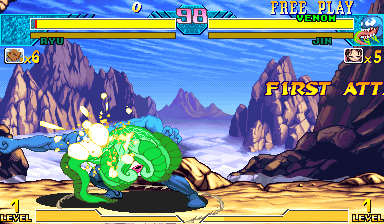
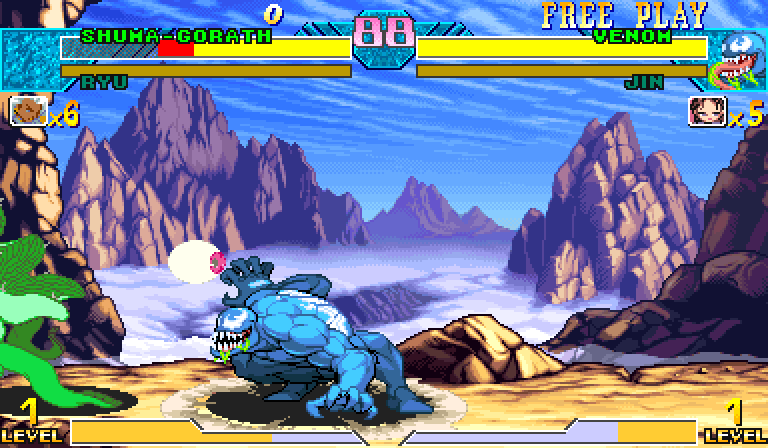
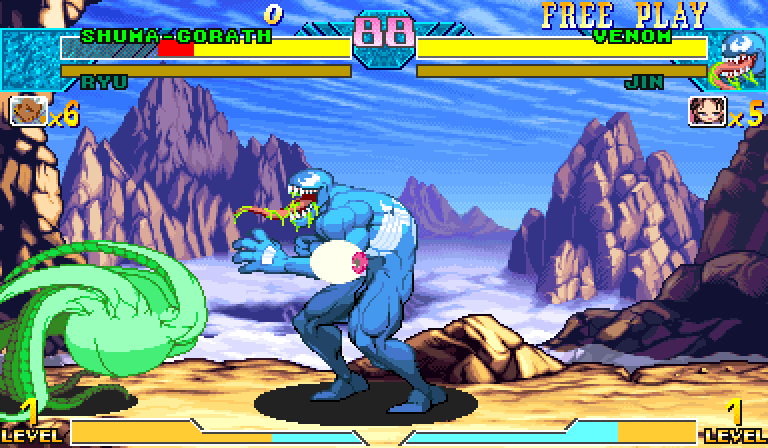
This is the payoff of the native era. Marvel vs Capcom 1 never had Shuma's Mystic Stare; teaching the 27-year-old engine to recognize the input (charge Back, then Forward + Punch) was the easy half. Making it fire was the hard half -- and it now does the whole thing: one cast spawns six eyeballs seeded at the six vertices of a ring.
flowchart TD
    IN["charge B to F plus P detected"] --> POSE["Mystic Stare pose<br/>8 anim frames, clean recover"]
    POSE --> ALLOC["object allocator $3FAE<br/>found by tracing a LIVE Ryu Hadouken"]
    ALLOC --> OBJ["pool object type $78<br/>owner Shuma"]
    OBJ --> DISP["type-$78 dispatch rerouted<br/>only 3 encrypted bytes"]
    DISP --> TRAMP["trampoline $23CF70"]
    TRAMP --> EYE["EYE_HANDLER $3FC8C0"]
    EYE --> MOVE["eyeball crosses 68px to 386px<br/>about 5px per frame"]
    RYU["Ryu Hadouken still fires<br/>stock-safe"] -.->|shares allocator| ALLOC
Two details make this honest engineering rather than a lucky poke. First, the object allocator $3FAE was found by tracing a live Ryu Hadouken, because static matching failed to locate it -- and Ryu's own Hadouken still fires afterward, which is the proof the reroute is stock-safe. Second, the type-$78 dispatch is rerouted with only 3 encrypted bytes into a trampoline ($23CF70) that jumps to a relocated EYE_HANDLER at $3FC8C0. The result was independently verified: the object is real, owned by Shuma, and it moves.
One cast fires all six eyeballs, each seeded at a vertex of a hexagonal ring (per-eyeball position offsets written at spawn) -- verified live on the build where it landed. A later build in the chain replaced the rigid formation with a target-relative orbit, phase seeded in object field $1E. What's still bounded: the eyeballs have no hitbox yet, they freeze during hitfreeze, and the ring has not been visually re-confirmed on the current tip (the last capture landed during the opponent's intro). The spawn-and-ring pipeline is proven; the weaponization is not done.
Honest Caveats
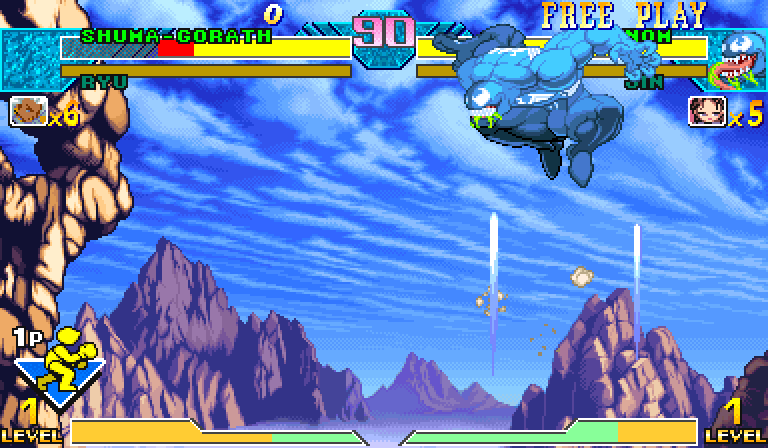
Shuma is a hybrid: his own code and animations, with his own walk rows (WALK_A-D), jump rows (JUMP_J1-J4, MSH idx5 data) and gravity now seated -- but residual Ryu physics clamps remain at other dispatch sites, which is why a mini "RYU" tag still shows under his lifebar portrait. Specifically:
- The moveset is incomplete, and the honest number is the identity gate. An earlier version of this list claimed the old donor build had more moves wired than the native -- a measured 29-move battery refuted that: zero moves confirmed lost. What's real is the moveset identity gate on the current tip: pass=11, FAIL=6 -- his supers, Devitalization, the stare/smash strength variants, and two command normals still collapse into other moves. The path forward remains driving Ryu's working move skeleton with Shuma's own animations and hitboxes.
- Voice routing is observed, not fully accepted.
$0D5EF4routes through helper$23C222to a Shuma table at$23C852, but a QSound command does not prove the correct banked sample is present and audible for every move. Dark Sakura's wrong sounds are still silenced, not replaced. - Supers remain semantically open. Devitalization, Chaos Dimension and Chaos Split can complete in the broad suite, but the measured attack/reaction pair collapses onto heavy-kick behavior. The stricter identity gate therefore overrides the survival result. Sekika (air d+MK) and Upward Stare (u+HP) landed as observations, and j.MK / j.HK rose from zero to 11/14 attack frames; all still need current source-to-destination consequence gates.
- Pre-fight walk-back is missing. (The win/KO crash is fixed --
$07D950clamped through thunk$23D4C8, and the win-condition probe readswin=1 survived=1-- and the dizzy softlock now exits.) - The blue vertical glitches rising from the ground are the boxshape VRAM-mirror columns at
$922000-- known root, poke-proven, unfixed. - The 64MB core breaks Fightcade netplay. He is an offline character until that changes.
Status
| Surface | State |
|---|---|
Secret commit, loads, fights native (block $0301DE..$032A3E -> $3FA060) | Working; 0 wild jumps, 0 non-boot resets (earlier audit in the chain) |
| Name both screens (SHUMA select, SHUMA-GORATH lifebar) | Working; Iron Spider gone; 6-dim adversarial pass |
| Master defect (past-end 23-entry reads) | 203-site census; fixes are reader-side clamps |
| Cumulative build chain | Historical gates are preserved; current-tip parity is accepted only by the August 8 lane manifest |
| Mystic Stare eyeball | Fires the 6-eyeball ring (verified when the ring landed; not visually re-confirmed on the tip); target-relative orbit landed in a later build; no hitbox yet; freezes in hitfreeze |
| Mystic Smash spikes + hitbox | Partial: 2-byte spike route and a live attack box were observed; smooth-form reset after passing the opponent remains open |
| Win/KO crash + dizzy softlock | Fixed ($07D950 clamp thunk $23D4C8; win-condition probe reads win=1 survived=1) |
| Voice table route | Observed ($0D5EF4 -> helper $23C222, table $23C852); full audible voice/effect matrix remains open |
| Air normals | j.MK / j.HK produced 11/14 attack frames in a prior gate; Sekika and Upward Stare are observed, with current consequence parity open |
Supers / pre-fight walk / identity-gate FAILs (pass=11 FAIL=6) | Open |
He shares the native recipe with Dark Sakura, and the honest theme of both ports is the same: the parts you can prove, you prove; the parts you cannot, you say so on the record. That rule matters more than usual here, because the reverse engineering itself was agent-driven -- and this character is where it failed loudest. A "spawns satellite objects" model for one of his attacks was built and shipped before an adversarial pass killed it; the real defect was a missing hitbox on the object that already existed, and the real fix was two bytes. The retraction is recorded, not quietly dropped.